Showing posts with label Colour. Show all posts

19 August 2012

Damien Hirst at Tate: Color and Hapticity

When couple of years ago I had a short interview with one of YBAs for my MA research, I wasn't profoundly aware of the whole group and their works. Gradually, I went to see some works by Mat Collishaw, Tracey Emin and other artists, and finally this interest brought me to visiting Damien Hisrt retrospective at Tate Modern during my business trip to London this month.

There is a number of iconic works on the show, which set forth the narratives running through his career, while I got interested in those which were created at the emergence of his practice.


A Picture of Tate Modern Booklet

Anthraquinone-1-Diazonium Chloride, 1994
Original Image Here

I like the referencce to the 20-th century abstract art. I find it in geometrical or 'scientific' approach to decisions on forming the plane of the painting, e.g. Josef Albers' Homage to the Square series was based on a pattern made of mathemtically formed square formats.


Hommage to the Square, 1959
Original Image Here

Nevertheless, while Albers explores the subjective color experience referring to his color studies (Albers graduated from Bauhaus, which had a particular approach to color), Damien Hisrt does not use any of traditional harmonies. I believe he does not explore colour from the viewpoint of colour perception, but investigates the colour as a phenomenon itself. I do think though that his works address viewers for their individual experiences of the piece rather than presenting his personal artistic opinion.


Spot Painting, 1986
Original Image Here

This geometrical approach in his Spot Paintings creates a system for generating an infinite, endless series of paintings in a variety of scales. 


Ethyl Fluoroacetate, 2008
Original Image Here

Made with such medium as domestic paint, they look very common and haptically well experienced. Taking the same size and circular shape on a plane they seemed to me like cuts of painted domestic surroundings: doors, windows, cabinets and other pieces. I believe that something Damien Hirst aims to reach in his work is universality, which lets the viewers form their own relationship with his work of art and their own individual interpretation.

14 June 2012

Sigalit Landau and her video artwork at the Solyanka Gallery in Moscow

Last Moscow Thursday I had a chance to visit Sigalit Landau retrospective opening at the Solyanka Gallery. I was truly impressed by her video work and felt sorry that I didn't manage to encounter with it earlier on Venice Biennale in 2011, where she presented an installation in the Israeli pavilion. 

Metaphoric and narrated, some of her work obtains a form in a medium of film. While she continually looks into reoccuring themes, their result is highly visual. Sensual, vibrant and full, they are not only a journey towards exploration of particular issues, but possess particular visual qualities, which are powerful both bodily and incorporeal.


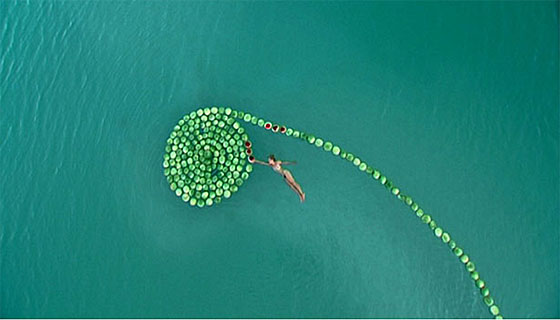
DeadSee, 2005
Original Image Here

DeadSee, 2005
Original Image Here


The movement of the depicted within the frame of the video is one of those things I find highly aesthetic in her work. She creates a comprehensive image, which does not obtain motion, but throughout the time forms a continuous sequence or series of images of their own. And so, it seems like there is a natural articulation in universal notion of cycle. Circular image turns into centrifugally unfolding spiral, moving within the volume of the sea. In the latter the changing pattern of light filmed from underneath the water reminds about the recurring pattern of the movement of the waves, governed by the cosmic bodies according to particular cycles. I believe this immersion in the sea evokes a desire for meditative contemplation of the universal image.


Under the Dead Sea, 2005
Original Image
Here


The nature of the abjects she films brings in particular colours and light to her work. While being on the plane of the video screen, they are spatial and engulfing, immersing the human body into the depths of the sea and presenting their relation within each other.

Standing on a Watermelon in the Dead Sea, 2005
Original Image Here


DeadSee, 2005
Original Image Here


Being so visually pleasant and mouthwateringly colourful, her works they are fleshy and tangible. Using salt, she preserves watermelons, and the imagination of the taste of the contradiction between the sweetest watermelons and saltest sea water clashes the senses.

The Dining Hall, 2007
 Original Image Here

I believe that her works are so touching and sensual not only because of multilayered narratives within them, but also because of the objects she choses to work with: flesh of the fruit, salt and her own body.

08 May 2012

Dale Chihuly and his Magical Worlds

Now I am in Moscow and probably for a good while. I still want to continue my investigations and in this post I want to write about the exhibition I have seen in London just before my leave. This was Dale Chihuly at Halcyon Gallery. I would like to point out that the reason why I made a step through the doors was something seen behind the spacious windows of the gallery, and it was not an object, but the atmosphere created by a number of those.

Halcyon Gallery, London
Original Image Here

Dale Chihuly says: 'when you're looking at glass you're looking at light', while I felt like I was looking at the coloured light, which was glowing from the far end of the staircase and flowing into the old boat just in the middle of the gallery space, like if it was brought here from somewhere magical. There light obtains shape.

Halcyon Gallery. Upstairs
Original Image Here

All his works seem like if they were probably not inspired by anything in particular, but taken from some artists imagination reality, which is formed, in my opinion, by practical engagement with the material. His objects are spontaneously developed, which is determined by the process of the glass blowing technque. This kind of work is complex: adding pigments to the glass is done a number of times and glass is melt everytime one is added, and all these should be done quite quickly. While the form is blown, fire and gravity take part in the process, and I think that probably because of these processes his objects look like a result of natural happenings, forming a series of them.

Persians
Original Image Here

Seaforms
Original Image Here

Team Glass Blowing
Original Image Here

Objects from the same series while made in the same technique, look as a result of a playful, experimental approach, like if the artist was curious every time about possibilities of glassblowing in each of them. I believe every object looks like a new step on the way to the whole journey. Nevertheless, his perfect knowledge of technique and high professionalism let him play with hot honey-like lquid glass in such a natural manner.

Original Image Here

While all the objects in his work are done in the same technique by blowing the glass, I find it interesting that each series is a result of particular hand movement. Work is done by a number of people and the steps made each time are the same, nevertheless every object is a result of different movement and every time there is something slightly varying in each of them, so every object and series objects form also become an ambodiment of physical motion.

Outdoor Fiori
Original Image Here

I really do enjoy that his works do have names, but not every particular piece. They determine the movement probably more that the meaning the artist imposes on them, and so by that these objects obtain the wholeness of their own.

Indoor Fiori
Original Image Here

I am simply really happy that I had a chance to engulf myself with the atmosphere, which was created by Dale Chihuly's objects. I believe that his works distinctly express not only his own imaginative reality, but the possibilities of highly masterful approach for the material and genuine fascination by its possibilities.


18 March 2012

Light and Colour in works by Libenský & Brychtová

The other day I was having a tutorial with students and one of them proposed application of stained glass in her project. She was introducing me to some illustrations representing works of art made of glass, when I noticed an absolutely stunning piece from Uměleckoprůmyslové museum in Prague. Though I visited Czech Republic couple of times and once even for art practice with group mates from Ural State Academy of Architecture and Arts, I have never been to the mentioned museum. You can have a look at the website here.

After doing a research it was exciting to realise how many techniques and their mixtures are applied in creating glass objects, nevertheless the one that took my attention included the process of casting. I enjoyed the works by Jan Exar, Frantisek Vizner, Gizela Sabokova and others. I was enchanted by spacious coloured glass objects transcending the light. 

Jan Exnar
Original Image
Here

Looking at CV's of some authors I realised that they were in the class at Academy of Applied Arts in Prague, atelier of Professor Stanislav Libenský (e.g. Gizela Sabokova). My interest went into studying works by him and his partner Jaroslava Brychtová. 

Gizela Sabokova
Original Image
Here

Gizela Sabokova
Original Image
Here


I wish I could see Libensky's and Brychtová's works live, but even on photographs they expose themselves to a viewer as something capturing and seductive. While having a spacious mass (some of them are about human size) they seem like if light obtains colour and by this their substance is formed.


Libensky & Brychtova, Green Eye of the Pyramid, 1922-23
Original Image
Here


I believe there is something illusionistic in their works what one might find in holographic works from 70-ies, and this evolving phantasmic dimension is filled with colour. It appears here originated from the engagement of light and glass mass. Nevertheless, the works do seem to me like light paintings in space, glass loses the matter and becomes a coloured light drawing floating in the space of those white galleries. Here the difference in thickness of glass and thus different translucency levels allow the medium to engage with and so reveal the full power of light and its way through the dimensions. Here the new value of these objects is born.


Libensky & Brychtova, Arcus
Original Image
Here


Libensky & Brychtova, Arcus I, 1990-99
Original Image Here


Here light becomes a medium which evokes new possibilities of the material it engages with. I do believe though that the strength of these works comes from a number of years of experimentation and practical learning of the technique. 


Stanislav Libensky with Red Pyramid
Original Image
Here


I enjoyed looking at his drawings as well. Seems like they explore more the journey of light rather than mass or composition.


Libensky, Triangle in the Triangle, 1996
Original Image Here


Libensky, Impress of an Angel, 1996
Original Image
Here

Seems to me that there is always a number of particular techniques working with every medium, e.g. glass casting used for creating these sculptures. Nevertheless, constant technique development and experiments lead to particular unconventionality even in works made of such an ancient material as glass. Moreover, this engagement with the work brings significant progress and development of the narrative.

I hope one day I'll have an opportunity to experience those works in museum or a gallery space and of course I don't forget about my small dream to explore glass as a medium.

09 March 2012

Colour and Light in the Works by Mark Rothko

Yesterday I gave my first lecture in Chelsea College of Art and Design named 'Finding a Narrative in the Precedent'. It touched on the subject of methodology in research-based projects, and main idea was to proclaim the importance of practical exploration of the precedents in order to define the area of the interest for the future research.

Lecture Auditorium

A Slide from Lecture Presentation

In my lecture as well as in the tutorial earlier there was a notion brought up several times: light and colour in works by an American artist Mark Rothko. There is a great book about him called 'About Rothko' by Dore Ashton. I read it couple of times while writing up my thesis.

Book about Rothko
Original Image
Here

His works fascinate me not only with their aesthetic side, but more with the notion they bring.
Firstly, I adore the power they project on the viewer. When I saw them alive in front of me in a room covered only by his paintings from the same series, I felt like I was absorbing colour, while very dark colours like visible ( visible because there are other colours behind those we see) plum, maroon, black and violets felt as if they were glowing with light. Standing in front of one closely brought a feeling of being 'inside' of the painting, behind its picture plane. It was adorable to realise that the engagement with the depicted on a surface seemed like a spatial experience. These works were on display at Tate Modern and I recommend to certainly come and have a look if they are still there.

Black on Maroon, 1958
Original Image
Here

Another point I mentioned in my lecture was the influence of particular technique and approach to work onto the nature of experiences while perceiving it. Every object or space that has imaginative value also has practical means of being created, and I believe that finding area of interest and forming research question happens through practical work. Thus we can gain a better understanding of the narrative it suggests.  Mark Rothko was into a complicated method of work, which included special technique of work with traditional oil paint by mixing it with turpentine, thinly layering it and and polishing every layer in order to achieve this magnetic effect. 


Mark Rothko with One of His Works
Original Image Here


Here is the video about his technique:


Though I like the works which were displayed in London, there are other more joyful and saturated paintings that would be wonderful to experience. I wish one day I have a chance to travel to New York and contemplate his luminous and vibrant works in MoMA. Here is one of those I really want to see:

Untitled, Mark Rothko, 1968
Original Image
Here